Welcome Culers To The Official Fc Barcelona Family Facebook Group.
Lens Equation. If the cartesian sign convention is used, the gaussian form of the lens equation becomes. If we place the object near the lens, we will get its image somewhere. From this quick sketch we can follow with the lens equation which gives us. In optics, a thin lens is a lens with a thickness (distance along the optical axis between the two surfaces of the lens) that is negligible compared to the radii of curvature of the lens surfaces. A simple lens consists of a single piece of transparent material, while a compound lens consists of several simple lenses (elements), usually arranged along a common axis. Thin lens equations & calculators. Examples of how the lens equation and ray diagrams can be used to find the principal focal point and image distance. Lenses whose thickness is not negligible are sometimes called thick lenses. The position, orientation, and size of this image depend on two. The position, orientation, and size of an image formed by a lens are determined by two things: This physics tutorial shows you how to use the thin lens equation / formula to calculate variables such as the image height and image distance in addition. Keep reading to learn about the thin lens thin lens equation. A lens is a transmissive optical device that focuses or disperses a light beam by means of refraction. Because in that convention the positive direction for a quantity is always in the direction that light is traveling. Thin lens equation calculator has been prepared to help you to analyze optical properties of the simple lens.
Mr Toogood Physics - Lenses. A simple lens consists of a single piece of transparent material, while a compound lens consists of several simple lenses (elements), usually arranged along a common axis. Examples of how the lens equation and ray diagrams can be used to find the principal focal point and image distance. Keep reading to learn about the thin lens thin lens equation. From this quick sketch we can follow with the lens equation which gives us. If the cartesian sign convention is used, the gaussian form of the lens equation becomes. A lens is a transmissive optical device that focuses or disperses a light beam by means of refraction. Because in that convention the positive direction for a quantity is always in the direction that light is traveling. If we place the object near the lens, we will get its image somewhere. The position, orientation, and size of this image depend on two. Thin lens equation calculator has been prepared to help you to analyze optical properties of the simple lens. This physics tutorial shows you how to use the thin lens equation / formula to calculate variables such as the image height and image distance in addition. The position, orientation, and size of an image formed by a lens are determined by two things: In optics, a thin lens is a lens with a thickness (distance along the optical axis between the two surfaces of the lens) that is negligible compared to the radii of curvature of the lens surfaces. Thin lens equations & calculators. Lenses whose thickness is not negligible are sometimes called thick lenses.
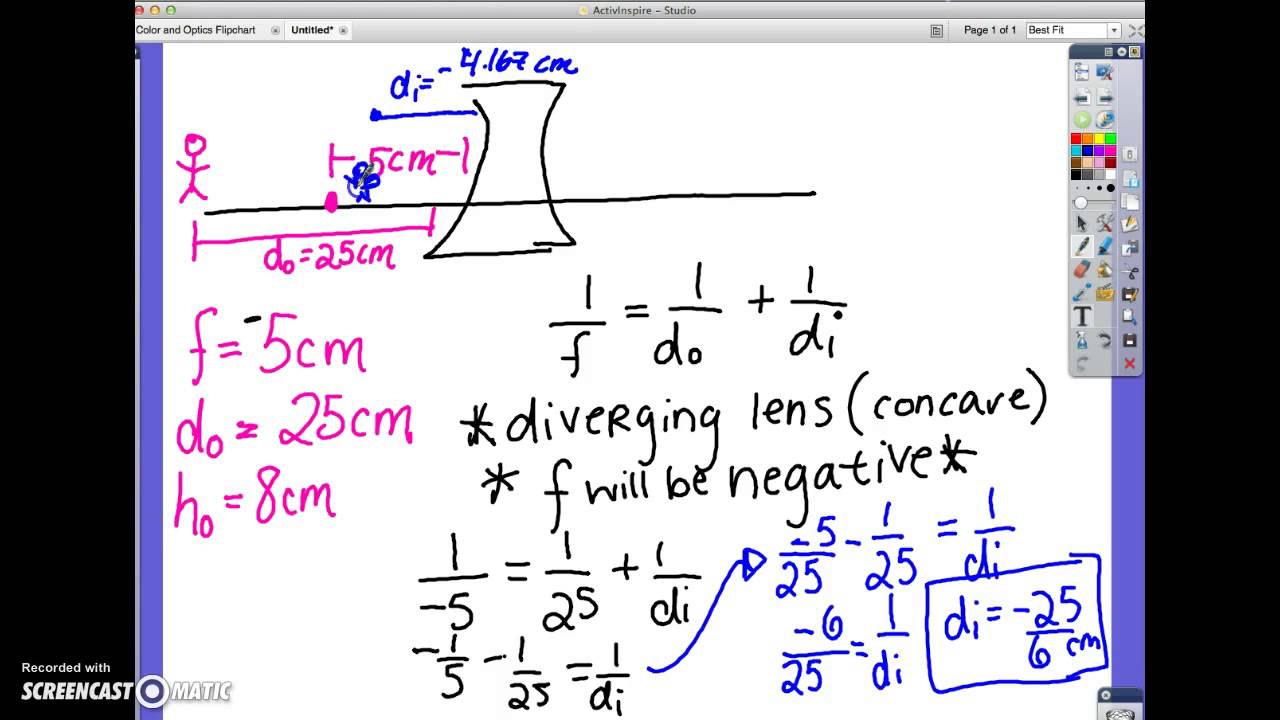
Lens Equation WS #4: Diverging Lens - YouTube from i.ytimg.com
The so called lens equation reads. Lens_equation #lens_formula oscillatory motion and related terminologies: A radius of curvature is positive when its center of curvature lies to the right of the surface, and negative when its center of curvatures lies to the left of. Solving for distance to image. A lens is a transmissive optical device that focuses or disperses a light beam by means of refraction. If you know the distance of the object you're magnifying from the lens and the focal length of the lens, finding the distance of the image is easy with the lens in our example problem, we can use the lens equation to find d i. Stay tuned with byju's and learn various other physics.
A lens is a transmissive optical device that focuses or disperses a light beam by means of refraction.
Solving for distance to image. The lensmakers equation relates the focal length of a simple lens with the spherical curvature of its two faces where and represent the radii of curvature of the lens surfaces closest to the light source on the left and lensmaker's equation. Consider a convex lens with an optical center o. What can be derived from this formula? Thin lens equation converging and dverging lens ray diagram & sign conventions подробнее. A converging lens has a focal length of 15 cm. Thin lens equations & calculators. Learn vocabulary, terms and more with flashcards, games and other study tools. Image formation by thin lenses. We can use the technique of ray tracing to illustrate how lenses form in many cases both of these equations are referred to together as the thin lens equation s. Plug in your values for f and d o and solve Students will learn how light behaves when passing through converging and diverging lenses. According to the same sign convention using which the above mentioned formula was derived, the answer 6 cm means the same. Solving for distance to image. The position, orientation, and size of this image depend on two. Could someone link a derivation of the thick lens equation so i could figure it out myself? Для просмотра онлайн кликните на видео ⤵. Because in that convention the positive direction for a quantity is always in the direction that light is traveling. The lens equation allows us to understand geometric optics in a quantitative way. Some examples of using the thin lens equation.created by david santopietro. R horan & m lavelle. The equation is as a demonstration of the effectiveness of the lens equation and magnification equation, consider the following sample problem and its solution. How does a lens form an image of an object? Ray tracing and thin lenses. If we place the object near the lens, we will get its image somewhere. The following formula, called the lensmaker equation, is used to determine whether a lens will behave as a converging or diverging lens based on the curvature of its faces and the relative indices of the lens material n1 and the surrounding medium n2. The lens equation expresses the quantitative relationship between the object distance (do), the image distance (di), and the focal length (f). From this quick sketch we can follow with the lens equation which gives us. This equation holds for all types of thin lenses. In part one of the thin lens equation lab, the goal was to observe the appearance and behavior of real images and determine the relationship between first, we attached an led light source to the track, that produced an image of the number four. The thin lens equations are broadly applicable to all.
Lens Equation . Could Someone Link A Derivation Of The Thick Lens Equation So I Could Figure It Out Myself?